I’m not one for horror films. I’m an enormous scaredy-cat with an overactive imagination and insomnia, so watching a scary movie is just asking for a week without sleep. I do love director Danny Boyle, however, and have since Shallow Grave. (I even love and own A Life Less Ordinary, and I’m not going to apologize for it.) When it became apparent that he was probably going to win a well-deserved Oscar for Slumdog Millionaire, I realized I’d fallen behind with his films and, being a nut for completion, decided to catch up. I’m not crazy about science fiction and yet I watched Sunshine. I’d never been interested in seeing The Beach, but I gave it a shot. Millions was adorable and a delight to watch. That left just the one, and it was the one that I had steadfastly refused to see for years because of the aforementioned fear of things that go bump in the night.
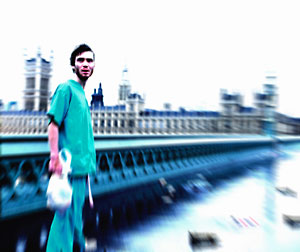 Yet again, I’ve got a bit of a fetish for finishing things, so it was only a matter of time before I saw 28 Days Later… as well. I watched it during the day, just to feel a bit safer, and was prepared to cover my eyes like the girly-girl that I am. Funny thing though… I loved the movie, and it’s the first that came to mind for today’s: “Movie I Thought I Wouldn’t Like but Ended Up Loving.” I wasn’t really scared and was at times very moved, bringing me to argue since that it’s not really a horror film at all. Those seem to be more about terrifying the audience or keeping them perpetually on edge, and there are very few “boo!” moments in this. It’s suspenseful, sure, but what I love about it is the incredible character development and its interesting message about the capacity of humans to lose their humanity when given enough of an excuse.
We follow the protagonist, Jim, as he wakes from a coma, alone in a changed world twenty-eight days after the outbreak. His greatest fear, coming from that experience, seems not to be of the “infected” themselves, but of being left on his own; he has a nightmare in the middle of the film whose terror is not the fear of imminent death but of desertion. One of the most affecting recurrent images in the film is of Jim repeatedly shouting, “hello!” into the deafening silence. He meets up with Selena, who has lived through the horror and has surely had to do unspeakable things to survive, and the two of them form a unit until they meet up with a father and his daughter, Hannah, who have made it through. The four of them become a family of sorts, which is a very comfortable situation for Jim, but not as much for Selena. Her fear is the opposite of his; getting too close to anyone, because to do so is to risk being slowed-down, or worse, the heartbreak of their loss.
The fascinating thing to watch is how they change from there. Selena starts to melt. Jim learns to be a grown-up and to take his place as patriarch and protector of this makeshift family. Hannah experiences the harshness from which her father had protected her and is ready at the end to actively contribute to their survival. That the epidemic is called the “Rage Virus” is fascinating, because it is by becoming enraged and embodying the behavior and tactics of the infected that Jim saves the day. However, it’s because he refuses to surrender his humanity that he fights those who are ready to give themselves over to the apocalypse. In the end, the message is that the only world worth living in is one that leaves room for hope.
The uber-famous scene from 28 Days Later is that of Jim walking through the deserted streets of London. I couldn’t find the full scene, but a piece of it is here, and it’s some of Boyle at his best. See the movie itself though – it will surprise you.