I had a difficult time deciding what I would write for today’s meme, “Best Movie Cast.” The topic brings to mind a great ensemble, something that has a large and varied group of actors telling a tale in which they’re essentially equally featured. Films like Magnolia, Little Miss Sunshine, and Glengarry Glen Ross were mentioned in the subsequent answers I read in other series online, and I agree with all of them, but I just couldn’t think of a flick in that vein about which I wanted to write. Then I thought of Sunset Blvd and about how I had been trying to think of which of these memes I could twist to accommodate it, and I realized that I wouldn’t have to make any adjustments at all. Well, except changing the connotation of the meme to something more like, “Best Movie Casting.”
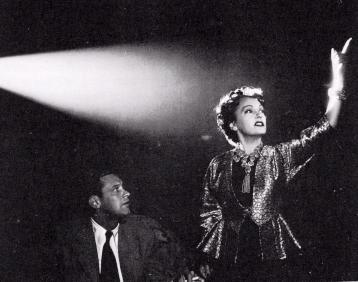 It’s hard to imagine any of the principals being played by anyone else, but the lead roles were intended at first for very different actors. For Norma Desmond, Billy Wilder considered Mae West, Greta Garbo, Pola Negri, Norma Shearer, and Mary Pickford, who were at turns wrong for it, shocked by the script, or insulted at the prospect. It was George Cukor who suggested Gloria Swanson, and when she balked at the screen test, he told her that it would be the role for which she would be remembered and that: “If they ask you to do ten screen tests, do ten screen tests, or I will personally shoot you.” And thank God, because she’s perfect. She has an extraordinarily huge presence for all of her 5’1″ frame, and though she was aging really very well, she gives a bravely bare and ugly performance. Wilder said in a 1975 interview: “There was a lot of Norma in her, you know.” The dozens of photographs from Swanson’s own past strewn about as props for Norma blur the line between the character and Swanson’s own history.
I have never found whether Erich von Stroheim was cast before or after Swanson, but his presence is so satisfyingly appropriate. He plays Max, the servant devoted to Norma, the one who stands by her and is actually responsible for the fantasy world in which she lives. The fact that Max was her director and the one who made her a star is terribly ironic historically. Swanson and von Stroheim made a film together at the end of the silent era called Queen Kelly which was not finished, though a version of it was released in 1931; only seventy minutes remained of what had been planned as a five-hour picture. It was Swanson herself who put an end to the shooting, as her production company was partly financing the behemoth, and the project effectively ended the career of its director. In Sunset Blvd, the film they’re screening at the Desmond home is Queen Kelly, and von Stroheim as Max is the one running the camera. There’s such a delicious undertone of resentment and ego-destruction in the relationship between the characters Swanson and von Stroheim play, and Billy Wilder had enough of a sadistic sense of humor to purposefully exploit it.
And then there’s beautiful, doomed William Holden. Signed by Paramount at the tender age of nineteen, starring opposite Barbara Stanwyck at the age of twenty, and by the age of thirty languishing in boy-next-door parts he’d outgrown, Holden was just itching for the chance to show something more onscreen by the time he was given the chance to put in for Sunset Blvd. The part of Joe Gillis was originally written for Montgomery Clift, who eventually backed-out, and the picture is far, far greater for it. Clift was an incredible actor, a sensitive performer who laid himself bare for each role, and who had the haunted look of a tortured soul. Though the casting of Norma and Max are brilliant as such, the casting of Clift as Gillis would have been disastrously on-the-nose.
What’s so effective about Holden in the part is that he’s a golden boy, a glorious, robust presence that we can see brought low by his failed career as a writer and the financial ruin that’s followed. Holden knew about compromise and cynicism and rationalization, and it’s all the more poignant written on the same face that carries Hollywood’s most dazzling smile. His delivery and narration is suitably light and wry, bringing the energy that carries us through the dark piece, and the movie would not be half as good without him. Super-stardom was at last his with Joe Gillis, and his performance ushered in a string of anti-heroes for himself and a generation of actors who followed.
I could write about William Holden all day and about Sunset Blvd for probably at least a few hundred words more, but I’ll try and wrap this up. Beyond the main casting (and I know I’ve skipped over Nancy Olson, but… wouldn’t you?), there’s the matter of Old Hollywood so brilliantly represented, with C.B. Demille, Buster Keaton, Hedda Hopper and others playing themselves, lending an air of authenticity that’s chilling. At its screening for the industry elite, Louis B. Mayer chastised Wilder saying, “You have disgraced the industry that made and fed you!” He may have, but in so doing, he breathed life into it that kept it running, and this movie has been beloved for decades since. If you see no other movie I’ve written about, see this.