My “Favorite Oscar-Nominated Film from a Recent Ballot?” Easy.
I saw Munich (2005) the night it came out, loved it, and believed it would rock people’s worlds. Then Brokeback Mountain arrived on the scene, and I heard little else about Munich beyond its nominations. Now… please don’t misunderstand me; I believe Brokeback and its director deserved every bit of praise (and certainly the Oscar that was a notorious exception in its sweep of the season), but I have always felt sad that Munich appeared to have gotten a bit lost in the process. It suffered from the controversial nature of it’s content, of course, but I feel like it’s more ignored than disdained.
It’s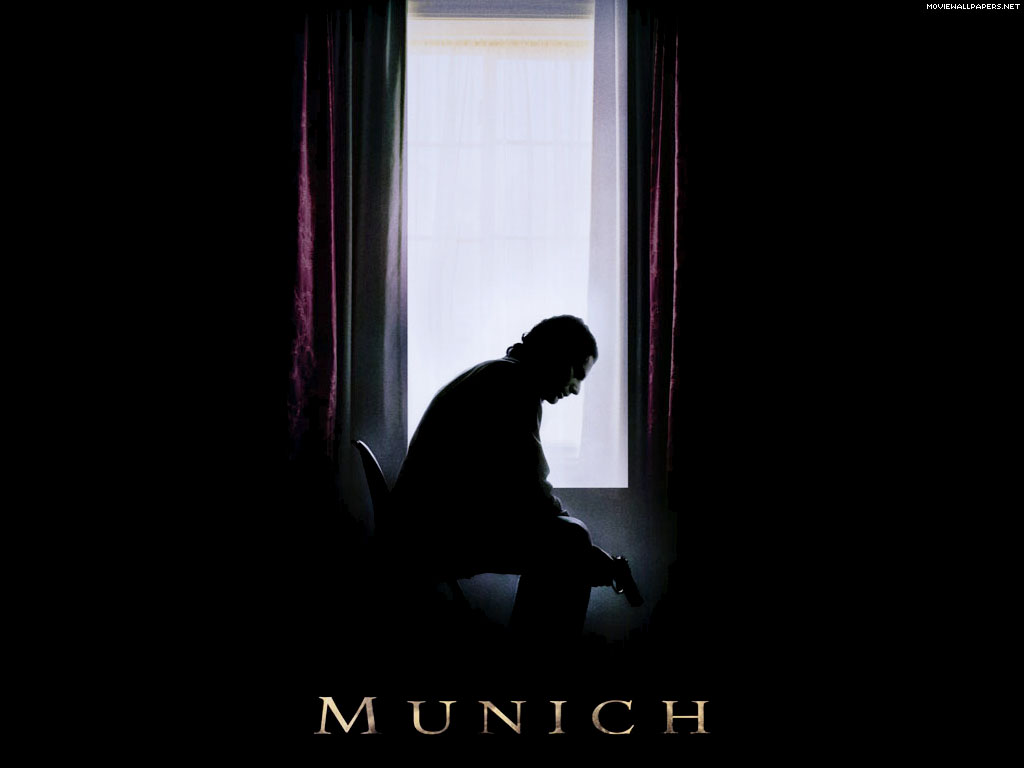 really an extraordinarily unsentimental film, even on a scale that takes into account the usual shmaltz of its creator. Though also typical of Spielberg is its even-handed treatment of all the players; you’d be hard-pressed to find more human and three-dimensional Nazis than in Schindler’s List, and you’d probably be surprised at how easy it is to empathize with the Palestinians in this film (hence, the controversy and the cries that Spielberg was “no friend of Israel”). But where List is far more about the identification of culture and religion for the Jews in it, Munich is about their political identity and its tie to the patch of ground they carved out to call their own. The screenplay is (primarily) by Tony Kushner, and who better to make sense of this impossible conflict? Having taken us from earth to hell to heaven (a place very much like San Francisco) and back, Kushner showed us that while there may be no Angels in America anymore, there is no place like home.
What I love about Munich is that it’s about home; how you define it, what it means to you, and the lengths to which you will go to protect it. Our protagonist, Avner (Eric Bana) was born in (and to) Israel and has lived his life in service to it. What he has to do for Israel changes him, however. His relationship to it is as a warrior for the Motherland; it’s the hook on which he hangs his identity. But he’s unable to justify his actions as having been right for Israel, much less righteous. In the end, none of it seems to have been worth it to him. His mother’s feelings on what he’s done, however, are unambiguous:
Everyone in Europe died – a huge family… I didn’t die because I came here. When I arrived, I walked to the top of a hill in Jerusalem and prayed… for a child. And I could feel every one of them praying with me. You are what we prayed for. What you did, you did for us. Every one of the ones who died, died wanting this. We had to take it, because no one would ever give it to us. A place on earth… we have a place on earth at last.
There is a cool irony that parents who give their children a world better than the one they faced actually create a child with the inability to fully appreciate what they’ve been given. In one incredible scene, Avner talks in a stairwell to a member of the PLO. When Avner asks him why he won’t give up, why he cannot see that they will never win, the young man replies that Avner has never known what it’s like not to have a home. “You say, ‘It’s nothing,’ but… you have a home to come back to. Home is everything.” And, “It will take a hundred years, but we’ll win. How long did it take the Jews to get their own country?”
It’s a stunning parallel that Avner’s mother has far more in common with the motivations and yearnings of a young Palestinian than her own son. She raised him to never have to feel that longing, to never know how desperate a man can get in his pursuit of it. It’s only one example of the complexity of Munich; it leaves you off-balance, drawing no conclusions and giving no answers. It’s not a comfortable movie to watch, but it’s extraordinary in its challenge to the audience to question the black and whites of the argument and accept the immutability of the gray.
The final shot of the film on which the credits roll is purposefully evocative, reminding us: “There is no peace at the end of this.”
*Before you run out and see Munich (as I know you’re now dying to do!), stop by Lara’s blog to see what fabulous and possibly overlooked television series she’s telling us about. She’s a gal on a mission, and I think some obscure gems are going to come out of her series.
You should write a mobile site. gayleamy.com is too complicated for my phone :)
God, Melissa… Just the normal re-design wears me out! But now, thank you very much, I’m probably going to look into having a mobile design of my wordpress if possible. I CURSE YOU!!! :)
I love you, Miss Gayle! Next time I am at a desktop, I will make sure to visit. I am sure it’s amazing – just too much for my phone to handle :) Sorry for stressing you out!
So… Turns out there’s a WordPress plugin (well, a number of them, and I picked one) that semi-automatically creates a mobile version of the site. I’ve enabled it, so you *should* be able to see it.
I’ve looked at it in a simulator and it seems to be working (though it’s so very much less pretty than my design. Do check that out if and when you reach one of these antiquated full-computer-thingies!)
Let me know how it works. :) <3
Oh, and… I rudely neglected to say: Thanks for going to read my blog!!! :)
Stunning, m’lady! So prompt, too! I promise to check out all the hard work you put into design as soon as I can. I have a few friends just posting you tube clips on fb, participating in the 30 days of music, but I love this. Apologies for the early criticism!
No, no worries! Just kidding you with it. :)